Strong emotions still course through this community, reflecting the deep investment many folks have in their identity, reputation and accomplishment as Penn Staters. This presents an immense opportunity for the new President.

The Sandusky events struck a deep chord. Much emotional pain, guilt, and embarrassment flowed from what is generally seen as flawed decision making inside Old Main – most critically the decisions in 2002, with varying opinions about later time periods. Folks now appreciate at a gut level that decision making inside Old Main can have major personal consequences, and that it can be a danger to assume that it’s always competent and well-guided. The threshold for political involvement is much lower than before, as evidenced by the healthcare controversy, the pipeline controversy, the childcare controversy, and persistent on-going general interest in University governance and transparency. Folks no longer give the benefit of the doubt to central decision makers. They are energized to participate in decisions and contribute their own small slice of expertise, opinion, and influence. Central decision makers have been put into a position of needing to prove competency in an environment that combines skepticism and hope.

Community members’ efforts to participate risk being perceived by decision makers as inconvenient or misguided meddling. Those perceptions are sometimes accurate, but sometimes fatefully not.

There is a huge energy here that could be harnessed for good. Few communities are so primed for deep change. But if left unrecognized or not channelled productively, these nascent urges towards shared governance will dissipate in frustration, misdirection, and cross-purposes.

It is an open space waiting to be filled by Presidential leadership.

Many directions are possible here. One out-of-the-box possibility came to me recently; since it comes from right field, please give me leave to briefly describe it. Penn State would benefit greatly by finding a new, compelling national profile to replace our current consequences-of-Sandusky media image. With our long history in energy research and development, including fossil fuels, we are ideally placed – as part Nixon-in-China, part Scientist-Engineer, part Jack-of-all-Trades across the whole human condition – to be the lead national university in the decadal world-wide transition to a new energy infrastructure that respects our responsibilities to our neighbors and our children. This is not a small task or a small decision – it will take real resources and real commitment – but it could repay many times in dollars, reputation, and impact. If we really mean it, then this initiative could change the narrative about Penn State, and channel great courses of community energy towards the best possible ends.

Will our new President grasp the opportunity, in this direction or another?

Confidentiality creates information asymmetry: I know something that you don’t. Sometimes this secrecy facilitates a successful outcome. Sometimes it protects vulnerable parties. Sometimes it imposes high costs.

To fully understand the ramifications of confidentiality, it’s helpful to ask: Who benefits from confidentiality in an executive search?

It benefits the executive search firm. The search firm knows the candidates for all of the searches under its purview, but each of its clients knows about only one. Privileged information creates commercial power, including the ability to sell access to this information or to selectively reveal it as a means of control. The reputation of the executive search firm also benefits if confidentiality contributes to a successful search outcome.

It benefits the decision making body. Secrecy obscures any embarrassing elements of a search process and also enables only the desired aspects of the final decision to be revealed. It smooths decision making and allows influence to be exerted in unmonitored settings. Confidentiality eases stress by giving a feeling of control. It concentrates the soft elements of decision making power. By expanding the pool of applicants it can raise searchers’ expectations for the outcome of the search. Confidentiality also concentrates responsibility for the outcome (this last aspect is not necessarily a benefit to the deciding body).

It benefits the applicants. Many applicants fear (often rightly) that awareness of their explorations could damage their position at their current employer. This means that confidential searches tend to attract a larger number of applicants, especially high visibility individuals who are willing to hide important facts from their current employers.

In every case, it’s the party with more information in a given relationship who receives the benefit of information asymmetry. The hope is that the institution as a whole will also benefit from confidential searches, even though its general membership is on the short side of every asymmetry. Keep in mind that every party to the search process – the firm, the search body, the applicant – obtains private benefits from confidentiality. Unless everyone is a saint, these private benefits will affect the design of the search and its progression.

The advantages of opening up at least the final stages of an executive search to public view include broadening the sense of ownership of the search process to create a stronger sense of inclusion in the community of interest and activating a broader base of expertise in assessing finalists. It is not so unusual. A search for the Chancellor of the University of Georgia system publicly identified the three finalists. A search for Provost of the University of Arizona invited the finalists to hold public fora at the university. A search for the President of the University of Utah publicly identified the finalists. We don’t have to scour obscure corners of the internet to find these: In two of these searches, one finalist was a then-current administrator at Penn State. In the third, David Smith was a finalist.

Partially lifting confidentiality midstream after expectations have been set is of course very different from defining an open search from the beginning. Any applicant would need to give express permission before a promised veil of confidentiality could be lifted. But if a candidate is unwilling to be publicly recognized as one of three finalists, then are they the sort who we want leading a university where “it will be important for the president to foster an atmosphere of openness and transparency“? (see page 8 of the linked pdf)

(As a final note, be wary if someone with access to vast stores of confidential information chooses to reveal some tiny subset of it in a manner that reinforces their self interest. Anything can be proven by selective disclosure from a large enough store of examples.)

The sudden redirection of the Presidential search effort raises questions of the mechanisms that enabled us to reach the stage where a morally bankrupt leader of a small second-tier medical school was invited to the threshold of the Penn State Presidency.

First, some information about David Smith. In early 2006 he abruptly resigned the presidency of Texas Tech: at the moment of his resignation, neither a permanent successor nor an interim replacement had been identified. Smith was already actively looking for a new job, but had not yet secured a follow-on position. A few months before he abruptly withdrew as one of three finalists for Chancellor of the University of Georgia system, on the eve of the announcement of the winner and for reasons unexplained. Word on the street at Texas Tech is that shady dealings were the likely instigator for these curious events. At Upstate Medical University (where Smith was President until just recently), the Executive Director of a company with major business dealing with the university, MedBest Medical Management Inc., serves as Senior Vice President for Administration and Finance has now retired from the position of Senior Vice President as a consequence of the ongoing investigation. In 2012, the undergraduate medical school at UMU was placed on probation by the Liaison Committee on Medical Education, an accreditation association, for fifteen deficiencies including an upswing in the number of student complaints of mistreatment or discrimination, below average student awareness of procedures to report mistreatment, a lack of basic science professors, students not obtaining grades on a timely basis, inconsistent application of criteria to students in clinical courses, little evidence that student feedback was used to improve education, no system to ensure formal feedback to students in some courses, and inadequate oversight of the rural training program. The past two deans of the undergraduate medical school have now resigned under unusual circumstances. UMU was also in hot water a few years back due to deficiencies in their contracting procedures, including a lack of written justification for contract awards. All of these red flags were available prior to the revelation of Smith’s undisclosed income, through web search. The prior resignation and withdrawal were easy to find. The accreditation issues took a bit of digging for someone at a distance from UMU, but they were also public knowledge and well-known in the UMU community.

Smith was apparently a very effective fundraiser, which may be related to his influence over the moneys that course through a large medical establishment and his apparent flexibility in deploying this influence. Of course, now we know that Smith also accepted undeclared compensation from two entities that had tens of millions of dollars in business dealings with the university (Medbest was one; the other, Pediatric Service Group LLP, was apparently a part of UMU). He has now resigned from the presidency of UMU in the middle of an investigation into his affairs. Upstate Medical is also now being audited by the New York State Comptroller.

So the question again: how did this gentleman ascend to the top of the search? In this regard, it’s interesting to note that the actual search procedure deviated from that described in the initial public announcement.

The initial announcement described an 18-person Search and Screen Committee composed entirely of university stakeholders (faculty, staff, students, alumni) and including no Trustees that was to “screen, review and evaluate all applications and nominations to identify a pool of candidates who warrant further consideration by the Trustee council”, and then “forward a short list of names to the Trustee Presidential Selection Council”. The Selection Council, composed of a subset of Trustees plus the chair of the current fundraising campaign, was supposed to “analyze the pool and narrow it further”. Finally the full Board of Trustees would appoint the President. An executive search firm would assist. In addition to its own meetings, the Search and Screen Committee was to “provide periodic updates to the Trustee council” and “hold several joint meetings” with the Council to discuss search progress.

The actual procedure involved certain members of the Selection Council actually participating in the searching and screening, functions originally ascribed to the Search and Screen Committee. This is clear from reading the Sept 2013 update on the official presidential search page: “The University Presidential Search and Screen Committee, along with representatives from the Trustee Presidential Selection Council, reviewed the lists of applicants, nominees, and individuals contacted” and “Karen Peetz, former Board Chair and Chair of the Trustee Presidential Selection Council, participated in the candidate reviews of the University Presidential Search and Screen Committee”. Kudos to the university for releasing this information, but one can raise concerns for the manner in which evidence for this deviation from the originally announced procedure was slipped into a later update focussed on trajectory, not process.

The meat of the search process is covered in a thick gravy of confidentiality, so we really don’t know how it is working. A short ranked list of candidates submitted by a Search and Screen Committee that sets its own rules of procedure and meets independently of the Selection Council is one pole. A long unranked list submitted by a Search and Screen Committee that operates under rules imposed by the Selection Council with active participation of Selection Council members is another pole. A short list would be more conducive to early and thorough background checks. A ranked list generated by non-Trustees and non-fundraisers would be more likely to tilt the balance of academic achievement and fundraising prowess towards the former. A long unranked list would deliver more decision-making power to the Selection Council, and the injection of the Selection Council into the searching and screening would perhaps be more likely to produce one or more candidates whose fundraising prowess obscured deleterious traits. You can update your Bayesian priors as desired based on the meager information that the conflagration of Smith has revealed.

The ready claim that “the search is confidential” greatly impairs input from outside. But perhaps one could obtain some purchase by asking questions based only on information already released by the university, i.e. the stated search procedure. Some creativity here might increase clarity while maintaining and supporting the integrity of the search.

This same confidentiality also prevents any dialogue with the Search and Screen Committee. A one-way conversation is still possible, so some advice to our searchers and screeners: recent events provide an occasion to clarify your committee’s prerogatives in advancing the search. Review the original Board decision that established the scope of your committee and follow its letter and spirit in a way that will ensure that your expertise and insights are fully and effectively incorporated into the process. This may mean making your own independent committee decisions on the proper number and ranking of candidates to convey to the Selection Council. You have soft power and leverage here that might not be readily apparent. Do not deflect responsibility for the Smith debacle entirely onto Isaacson, Miller (who one assumes was supposed to have performed a more timely background check): ultimately, the Selection Council holds the largest measure of responsibility for choosing this candidate. Many red flags here required only a few minutes of googling, well within the expertise of anyone willing to assume the personally accessible part of mission critical tasks. Being a Trustee must get one used to depending on staff and outside consultants for expertise. This is understandable and necessary – it’s a tough job – but good-quality decisions also depend on the decision makers being able to ask hard, pointed and well-informed questions of their experts, cross-checking against whatever independent information is available to the decider. At minimum, it requires a bit of googling and the strength of character and humility to admit mistakes, if only privately. Best wishes to all – searchers, screeners, and selectors – in moving forward on the challenging road ahead.

This thought-provoking article by Andrew O’Hagan on the scandal surrounding Jimmy Savile describes the role of social forces in perceptions of conduct towards children.

Attorneys for Tim Curley and Gary Schultz are claiming that Tim and Gary thought that Cynthia Baldwin was representing them at the grand jury. This is interesting. In that room, there were two parties potentially exposed by the grand jury proceedings: the people (TC and GS) and the institution (PSU). But there was only one lawyer (CB). One lawyer can only represent one client. GS and TC are smart enough to know that two does not equal one. So this suggests that, at some level, they did not – at that time – make a distinction between themselves and their employer. They were… Penn State.

The precise role played by the potential imposition of suspension of play (the “death penalty”) in the discussions between Penn State and the NCAA is murky and will likely remain so. For the purposes of this discussion, I’ll assume that the possibility was raised in a plausibly deniable manner. Instead, I want to focus on a different power dynamic: did Penn State have any concrete leverage over the NCAA, i.e. something beyond plaintive moral suasion?

In negotiation, don’t focus on what you want; focus on with the other party wants. Ironically, a major source of damage to Penn State – the reputational cost of being associated with pedophilia – was also the only leverage that Penn State had over the NCAA. The NCAA wanted to minimize the number of news stories that paired the concepts “NCAA” and “pedophile”. Thus they needed the enforcement action to conclude rapidly. Penn State’s only tangible leverage was its ability to prolong the enforcement action and thus keep the NCAA in the story. The Freeh report recommended that Penn State involve the full Board of Trustees more closely in important decisions; that would be a slow process, but one that the NCAA would have a hard time denying, since they leaned heavily on the same report. The NCAA demanded that there be no leaks, and a full board discussion would risk leaks. So to minimize risk, one would need to credibly convince the NCAA that a long delay would be forthcoming without formally committing to that delay, and then carefully assess the NCAA’s response.

I am curious whether Penn State deployed this leverage in the negotiations.

In light of the upcoming Board of Trustees retreat, I wanted to repost this earlier essay on pride and identity.

Support

and academics

University administrators have obviously received advice to consistently emphasize the phrase “move forward” in public commentary on anything Sandusky-related (occasionally combined with a denigration of “looking backward”). I understand the advantages of message discipline here, but I worry that a continued emphasis on ‘forward’ will prevent the community from doing the hard work needed to come to terms with the past. We don’t want the phrase “moving forward” to evoke an image of a person who stares straight ahead because they are afraid of what might be behind them.

This sort of work can be difficult, easily misunderstood, unpleasant, divisive, disorienting, incomplete, and extremely healthy and energizing.

Let’s consider a recent statement from the Chair of the Board of Trustees, regarding reactions to the Erickson’s decision to accept the consent decree on NCAA sanctions.

The quotes I find interesting and important are as follows:

  • “…there has been a considerable amount of confusion and misinformation about how the university came to its decision to accept the consent decree…”
  • “…will ensure there is no misunderstanding or further confusion as to where the board stands on this matter.”
  • “I appreciate everyone’s candor and your sincere and heartfelt comments.”

The emphasis on confusion and misinformation is accurate – there has been much of both. But by recognizing only confusion and misinformation, this statement implicitly delegitimizes others’ reactions to the decision: ‘If only you weren’t so confused and misinformed, you would agree with me’. The recognition of sincerity and heartfelt comments is similar; it acts at the level of sentiment and avoids the issue of whether any of the reactions may have been substantive.

This is a typical communications strategy, but I would hope for better, since open and healthy communications and decision making requires a recognition of the substantive legitimacy of opposing views. The process by which the consent decree was accepted is certainly open to substantive inquiry and discussion.

p.s. My source for these comments is simply a CDT story, which contains only partial quotes. Perhaps a different portion of the statement does open the door to recognizing the legitimacy of opposing views and the value of vigorous disagreement in decision making… if so, please let me know.

Recently I have had several intense, heartfelt conversations about the NCAA sanctions, specifically whether it is appropriate to punish an institution as a whole for actions of individuals within, when it is possible to punish the individuals directly. This discussion raises an issue of institutional coherence, i.e. the treatment of a whole institution as a single coherent entity, with rights and responsibilities similar to those of a person.

Human beings are wired to recognize and organize our worlds in terms of interactions between people: these are the skills favored by our development as social creatures. We are then naturally equipped to interact with outside organizations – tribes, firms, institutions – as if they are people also: we have a relationship to each one. The word “corporation” derives from the Latin “corporare,” meaning to combine in one body. This tendency to process relationships to and between organizations as similar to relationships between people is a useful societal organizing principle, since it enables a shared understanding of collective acts. But one must keep in mind the limits of this tendency: organizations are not really people.

“Not on my watch”

A good and proper leader will resign if their organization fails in a major way, even if they were not themselves aware of the incipient failure. Why? To reinforce the obligation that leaders have to support and reinforce the institutional practices and culture that minimize the chances of failure. This obligation to resign is arguably not fair to the individual, but y’know, leadership itself is not fair: why should one person have power over another? With that unfair power comes unfair obligations. Both are necessary for a society as a whole to function well.

This much – the responsibilities of good leaders towards their organizations – is I hope largely uncontroversial. Now what of the responsibilities of the non-leaders within an organization?

An individual at Penn State gains if a different member of Penn State wins a Nobel Prize or a national championship, or achieves some other goal that elevates the university’s reputation. To what extent is this reward justified? I see two ways. First, an achievement by one member of an institution provides new information to society as a whole about the quality of that institution, and this information may legitimately reflect upon the quality of other individuals who that institution has seen fit to accept as members. But the sense of reward that other members feel at the achievement of a colleague seems to exceed what is justified by this diffuse and indirect reflection. A second mechanism has come into play: the human tendency to identify in groups, and to think of a group as a collective person, corporare. We accept the reward because we are part of the group. We did well. Do we accept the failures to the same, more, or lesser extent?

Summing up

An organization often engages in relationships with other entities as if it was a really big person. This identification is obviously objectively wrong – institutions are not people – but nevertheless the anthropomorphism has value: It provides a shared, automatic, unconscious understanding of how to organize society, and it creates obligations amongst all members of an organization towards reinforcing practices and culture that contribute to success and minimize the chance of failure. A good and proper leader has such obligations even beyond their immediate sphere of knowledge and awareness. They accept both the rewards and the punishments that flow from this understanding. Should the non-leaders within an organization share these rewards and punishments, or does that spread the responsibility too far?

Recent events have rightfully damaged public confidence in Penn State’s internal procedures for handling evidence of unethical behavior by members of the university community. How can confidence be re-established? Let’s approach the big question by asking some smaller ones. Consider the interplay between confidence and confidentiality.

It may surprise some readers to learn that the veil of secrecy as regards the practice and outcome of ethics inquiries at Penn State can extend even to the alleged victims and reporters of possible misconduct. Current policy, as I understand it, states that the findings of ethics investigations are held secret by the administration. Disciplinary actions are never shared, and findings of misconduct or lack thereof are not shared with victims unless they are also the reporters. In addition, the reasoning used to justify the conclusions of ethics investigations is not shared, even with those who reported the behavior. Obviously, the Freeh report – shared openly – is a massive exception to this policy. But my understanding is that the policy of secrecy still stands as the default course of action for all other misconduct investigations. (If I am wrong, please send me a note outlining the evidence to the contrary).

Should a victim of an ethics violation be informed of the outcome of ethics investigation, if s/he is not also the reporter? 

Should those who make ethics allegations be informed of the basis for decisions reached in the resulting investigations?

Does a policy of secrecy contribute towards developing public confidence in the quality of Penn State’s ethics decision making?

Confidentiality has costs and benefits to all parties involved: the accused, the accuser, the victim, the institution, the general public. Confidentiality protects from adverse public reactions against reporter (who may be anxious and vulnerable), the accused (who may be wrongly accused) and the decision makers (who may benefit from a lack of public scrutiny of their deliberations). On the cost side of the ledger, decision makers in secret proceedings know that their reasoning will not be subject to public scrutiny and thus weak decisions will not be exposed. Also, wise decisions will neither educate the wider community nor contribute to an institutional or personal reputation for making good decisions. The tradeoff of cost and benefit is complex. Let’s try to clarify the issue by  briefly expanding the scope of discussion from institutional ethics proceedings to the broader governmental criminal and civil justice system, a system with which most people are more familiar.

Would you rather stand accused of misconduct in a country with open court proceedings and public decisions, or in a country with closed proceedings and secret decisions? 

Of course a criminal justice system is different from an institutional ethics system, but perhaps the analogy is enlightening.

Making administrative decisions is difficult and stressful. From the administrator’s point of view, the process would be tidier and more easily managed if the public could not view the progress of investigations or the content of final decisions.Secrecy is thus attractive to the administrative mind, independent of its positive and negative effects on the other parties involved. Where a subtle balance of costs and benefits is involved and the decision-makers themselves individually benefit from secrecy, then policy will naturally skew towards secrecy over time. If the decision-makers are also the policy-makers, then policy on ethics investigations will tend to drift towards excess secrecy in the absence of a sustained, overt institutional effort to counteract this natural tendency. Excess secrecy will then tend to weaken the rigor of the resulting decisions.  This is not malfeasance: every incremental policy decision towards secrecy will have an admirable justification in the conscience of the decider. But the aggregate trend is worrisome and can be damaging to an institution, especially since the worst decisions are sometimes taken by people who convince themselves that they are making good decisions.

Current practice (I do not call it a policy since I don’t think any conscious policy decision was involved here) is that the general members of the Penn State community are educated in proper ethical conduct not from actual decisions at Penn State (which are generally held secret, as discussed above), but from secondary sources such as training materials, media reports, or rumors. High-quality scholarship requires critical analysis and discussion of primary sources, the type of rigorous inquiry that has established Penn State as a leading research university.

Does a practice of hiding primary ethics source material contribute towards developing community understanding of ethical principles and procedures? 

Should faculty, staff and students – and the wider Penn State community – learn of proper ethical conduct from primary or secondary sources?

(This essay was originally written in early 2012, but not posted until now, so it doesn’t reflect recent events such as the the Freeh report or the NCAA penalties. Neverthelss, I thought I would post it largely unrevised, to capture some thoughts from that earlier time. I did add a reference to the word ‘humane’ and three sentences at the very end.)

Pride and Identity

The focus of this post is not to directly address the sadness, anger or discomfort in the community due to the damage Sandusky caused, nor to try to repair Penn State’s reputation. How we feel and what people think of us is unimportant compared to our obligation to identify and address the causes of failure. Understanding causes is crucial to the long-term health and reputation of Penn State as both an institution and as a collection of individuals.

To support victim services and research into preventing child abuse is penance. Penance is an important acknowledgement of shared responsibility, but an incomplete response to scandal: anyone can support efforts towards prevention and helping victims, but only Penn Staters can identify and cure a problem with our own culture. To the extent that a community’s pride derives from a sense of shared responsibility for accomplishment, it also obligates a sense of shared responsibility for failure.

The problem: lack of report 

McQueary could have reported Sandusky’s conduct to non-Penn State legal authorities but he did not. His father could have but did not. Their family friend could have but did not. Paterno could have but did not. Schultz could have but did not. Curley could have but did not. The janitor who saw similar things on another occasion could have but did not. The janitor’s colleagues could have but did not. All of the reporting that did occur remained within the cultural family and elicited a tepid response. Assumptions and decisions were made to minimize the perceived severity of offenses. The only reporting that projected outside of the cultural family and reached the police was initiated by mothers.

A diagnosis: pride

Pride in oneself is a form of self-reward: I did well and I allow myself to recognize that. Pride in the accomplishments of another person is empathic. A parent who is proud of a child is not thinking of how the child’s achievements reflect on their abilities as a parent. Instead, the wall of identity between the two dissolves and the parent temporarily becomes the child, thereby sharing and reinforcing the sense of accomplishment from which pride derives, within the protective and nurturing glow of parenthood.

Pride in a group of which one is a member comes in two forms that I will call communal and tribal. Communal pride derives from shared effort: I am proud of the group’s accomplishment because I contributed to it. Think of the pride of a corporate design team that delivers a successful product through significant, concrete contributions from every team member. Tribal pride does not require a concrete personal contribution: I am proud of the accomplishments of some members of the group – achievements to which I myself did not substantially contribute – simply because the wall of identity between myself and the accomplishers has dissolved: they are me. Tribal pride has a spiritual quality. I am proud of Penn State when the football team wins, although my only contribution was to cheer and feel, actions which required no skill and did not contribute to the victory to a degree commensurate to my emotional investment.

Why the lack of report of Sandusky’s behavior? Most inaction is ultimately caused by fear. Fears have many sources, overt and deep. Let me pick out a subtle one that strikes deeper than the fear of bad publicity. To report Sandusky’s behavior outside of the cultural circle would establish it as part of the shared tribal identity, as an acknowledged characteristic of the cultural circle in relation to outside observers. This fear is at heart not a fear of repercussions (although certainly that fear exists). Instead it derives from a danger to one’s own identity. I am the football team. The good of the football team is part of me. I am Sandusky. The bad of Sandusky is part of me. Identity dissolves. We recoil in disgust.

We reject him from the group, yes, but only after he was invited in.

How can reasonable people manage to ignore the reporting obligations that follow from evidence of wrongdoing? We are defined as much or more by what we do not think as by that which we do: the brain at every moment must choose one conscious thought from among thousands of possibilities: these are not decisions in the normal sense, but instead a function of the deeper substrate of mind. The 99.9% of thoughts not taken often provide more insight than do the visible 0.1%.

This mental filter takes many forms: unwillingness to hear, compulsion not to examine, inability to confront. Not-thinking skills amplify by reflection between actors in a shared culture, through unconscious signaling or shared presumptions. Discomfiting details can be skirted. Reasons can be found to minimize. Collective attention can be focussed on reassuring distractors (reinforced by shared key words: “humane”) rather than disturbing possibilities (victims, confrontation, embarrassment, threats to identity and interests).

The process need not be conscious and often isn’t. Avoidance is most insidious when it’s unconscious, since that circumvents the executive quality-control regions of the brain. It can take the subtle form of momentary glances and body language; these are especially effective when exchanged amongst people who share a desire to avoid the same 0.1%. No-one wants to think of themselves as unethical, so reasons for decisions will be found. Even very bad decisions.

We are all responsible – at some level – for the filters that define what we willfully or not-so-willfully ignore.

Concluding thoughts

The shared identity of tribal pride is particularly effective when centered around individual exemplars. The longer a particular exemplar persists, the stronger the cultural anchor. Exemplars of shared identity reach that station through veneration. Thoughtful veneration for cause is admirable; unthinking veneration for identity is useful for social organization but can be dangerous for public choices.

Communal pride is extraordinarily powerful. It can enable soaring accomplishments of positive impact. But power is not goodness and from it can flow both darkness and light.

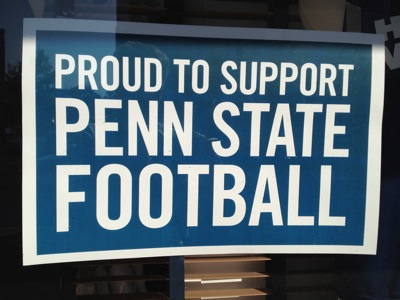
In reading the news, commentary and communications about the Sandusky scandal, I felt that a forum to explore meaning and culture, identify causes, propose solutions, engage in a communal effort to understand, acknowledge, and react constructively might be helpful. This is my own weak attempt towards those ends.

I hope to elicit comments, thoughts, reactions, and contributions.